Editing User Settings
User settings live in a .cycuser file next to a project's .cycproj file.
They hold private, machine-specific configuration such as browser and driver paths, report output choices, email summary options, known hosts, stored credentials, and data store settings.
These are the same files Cycle uses at runtime.
In the Cycle Desktop IDE, project settings and user settings appear together under one set of settings views.
In the Cycle Testing VS Code Extension, each settings file has its own editor.
Open the .cycuser visual or text editor to change user settings.
Open the .cycproj editor separately to change project settings.
The extension provides a visual editor for everyday changes and a text editor with JSON and schema validation for raw or advanced edits and for fixing parse errors. Prefer the visual editor.
For what individual settings mean, see Cycle Settings.
Opening user settings
Open user settings with any of these methods:
- In the Explorer, open a saved
.cycuserfile. - Open the Command Palette (
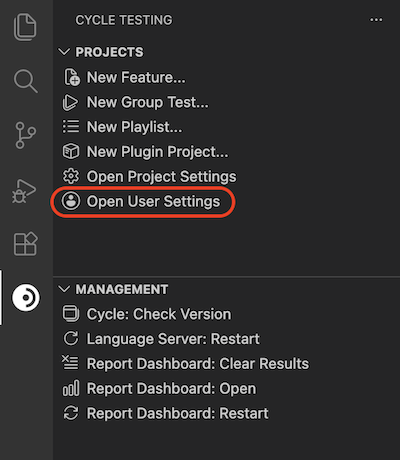
F1orCtrl-Shift-P) and run Cycle: Open User Settings. - Open the Cycle Testing activity bar and, under Projects, run Open User Settings.
Here is where to open it from the Cycle Testing activity bar:
Opening a saved .cycuser file opens the visual editor by default.
When you use Cycle: Open User Settings or Open User Settings from the activity bar, the extension first resolves a project settings file the same way as Cycle: Open Project Settings.
It looks for .cycproj files in the workspace root folder(s) only, then looks for .cycuser files next to that .cycproj.
| Result | Behavior |
|---|---|
No .cycuser found | Warning: No .cycuser file found next to the project file. with an action to Create User Settings |
One .cycuser found | Opens that file in the visual editor |
Multiple .cycuser files found | Quick Pick titled Select a user settings file |
Creating user settings
If no .cycuser file exists next to the selected .cycproj, choose Create User Settings from the warning.
- Enter the user settings file name in the prompt Enter the user settings file name.
The placeholder is
username. - Provide a required name with no path separators.
Do not type
.cycuser. The extension appends that extension automatically. - The extension creates the file beside the selected
.cycprojand opens it in the visual editor.
Using the visual editor
When you open a saved .cycuser file, VS Code opens the user settings visual editor by default.
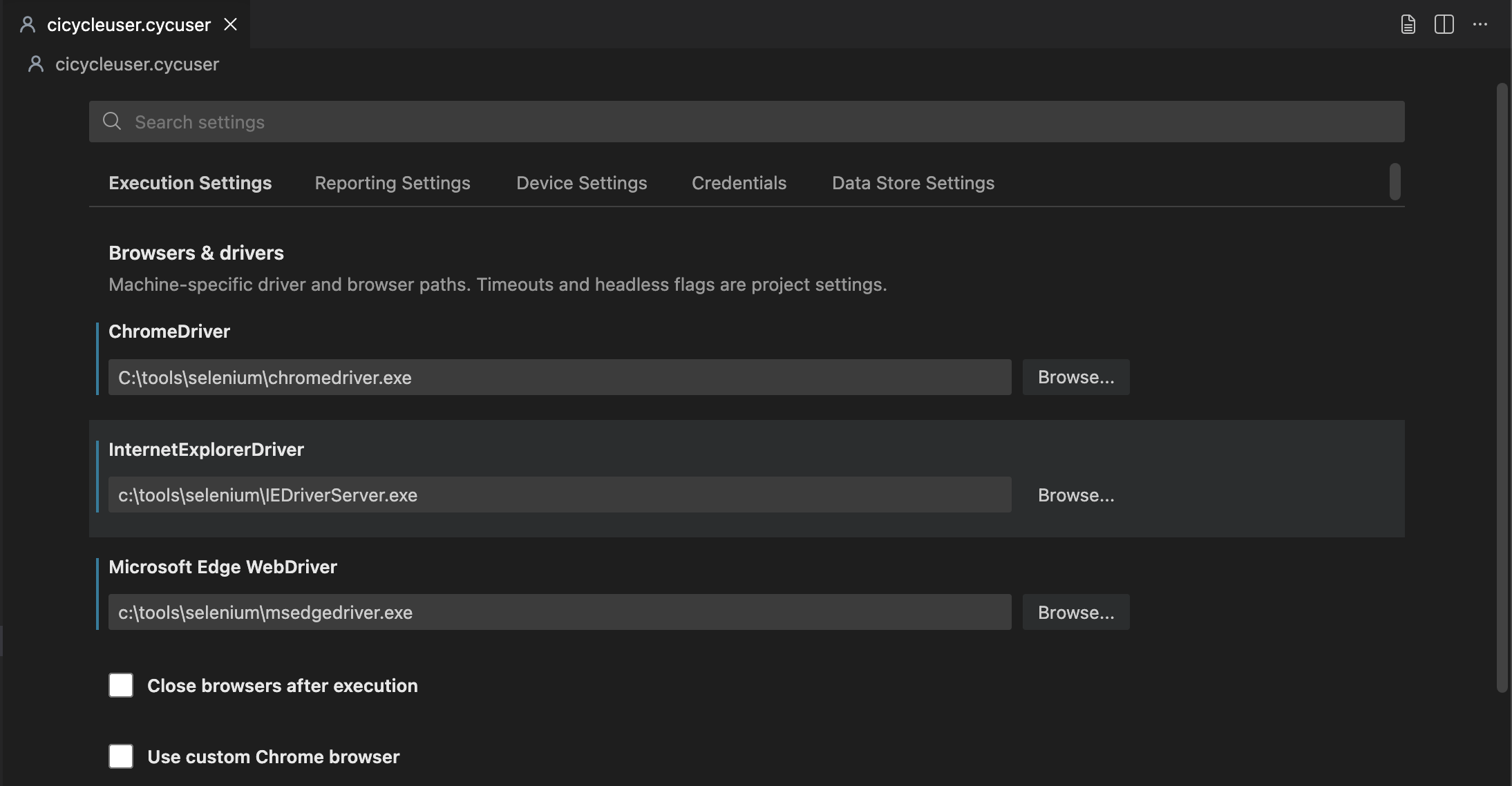
Tabs match the Desktop IDE-style user pages.
| Tab | Sections |
|---|---|
| Execution Settings |
|
| Reporting Settings |
|
| Device Settings |
|
| Credentials |
|
| Data Store Settings |
|
Searching settings
The editor includes a Search settings box.
Search filters settings within the active tab only.
When nothing matches, the editor shows No settings match your search.
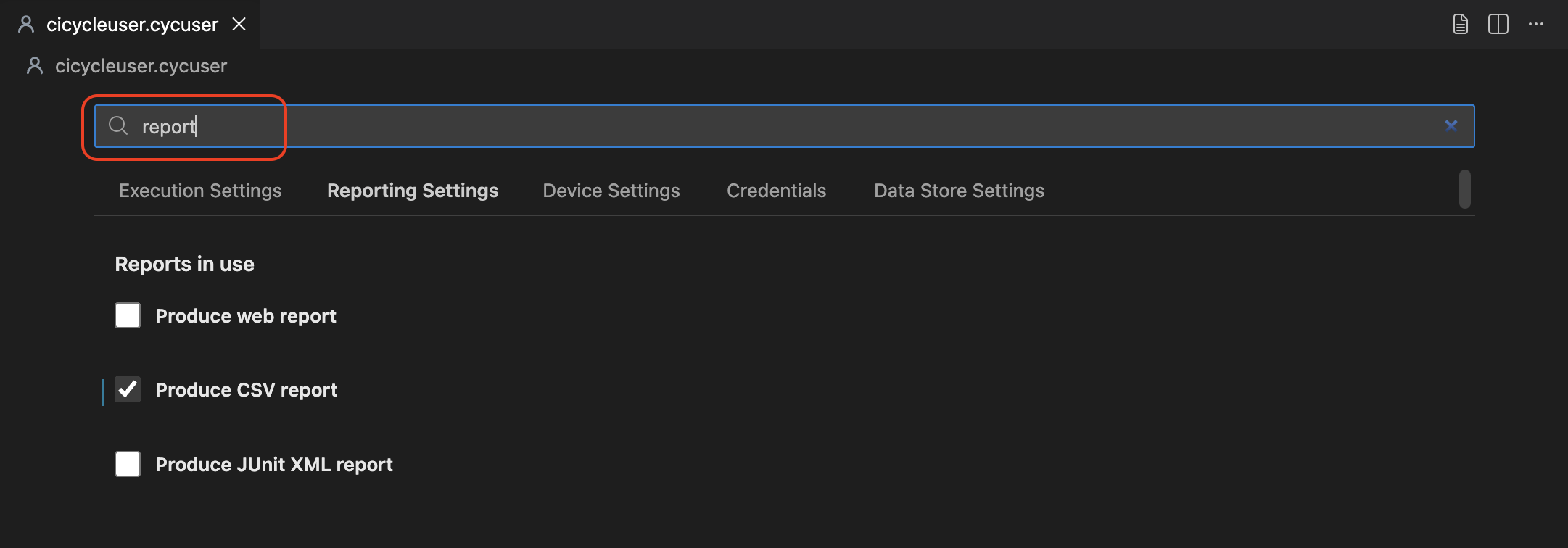
Editing credentials
Credentials are stored in the user .cycuser file under the Credentials tab.
The editor shows a list plus a detail form.
- Click Add credential.
- Enter a Credential name, Username, and Password.
- Use show/hide on the password field as needed, then save the settings file.
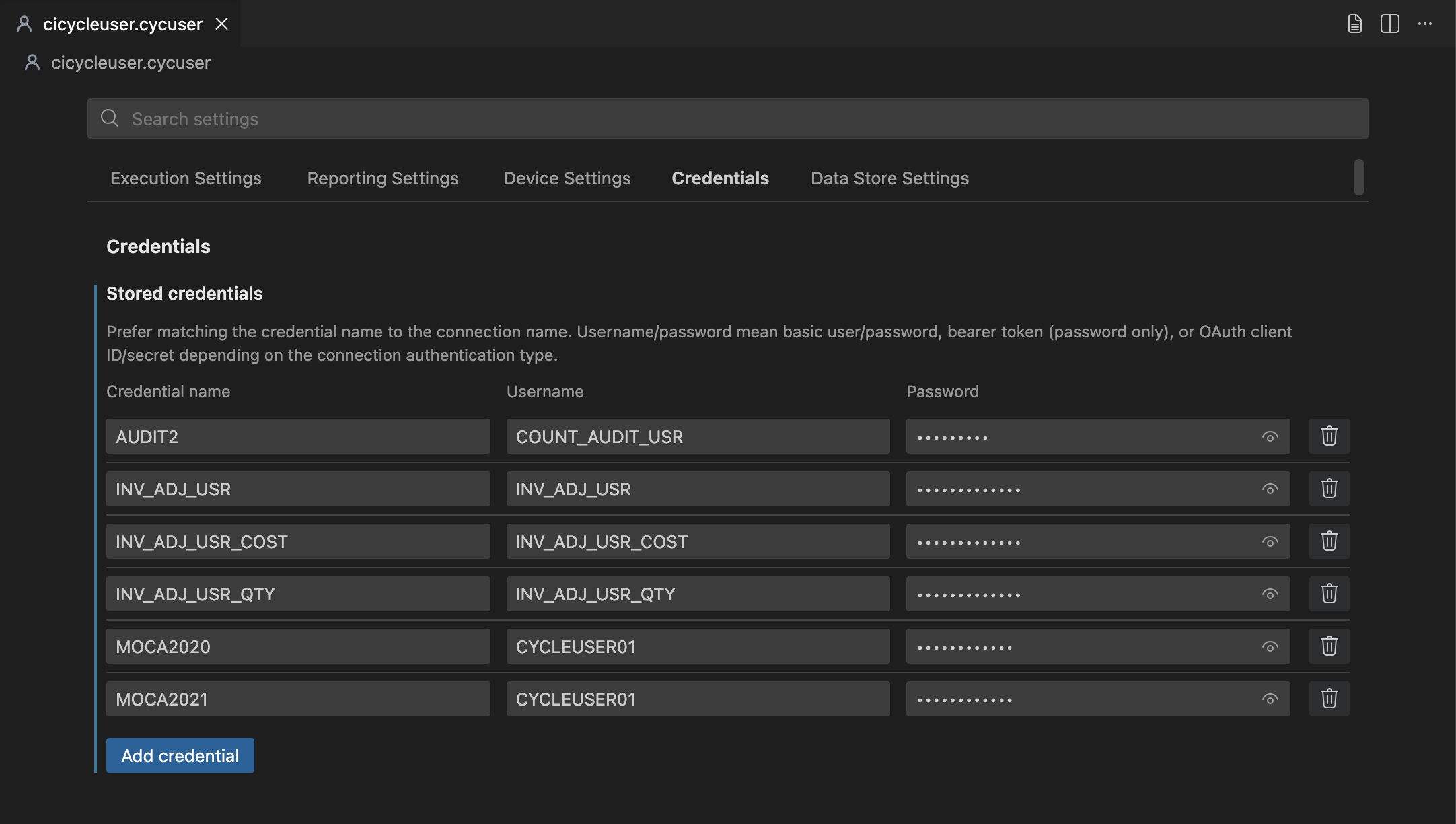
When the list is empty, the editor shows No credentials yet.
Prefer matching the credential name to the connection name. Depending on the connection auth type, username and password mean basic user and password, a bearer token (password only), or an OAuth client ID and secret.
Connections stay in .cycproj.
Credentials stay in .cycuser.
See Editing Project Settings for the connections editor.
Using the text editor
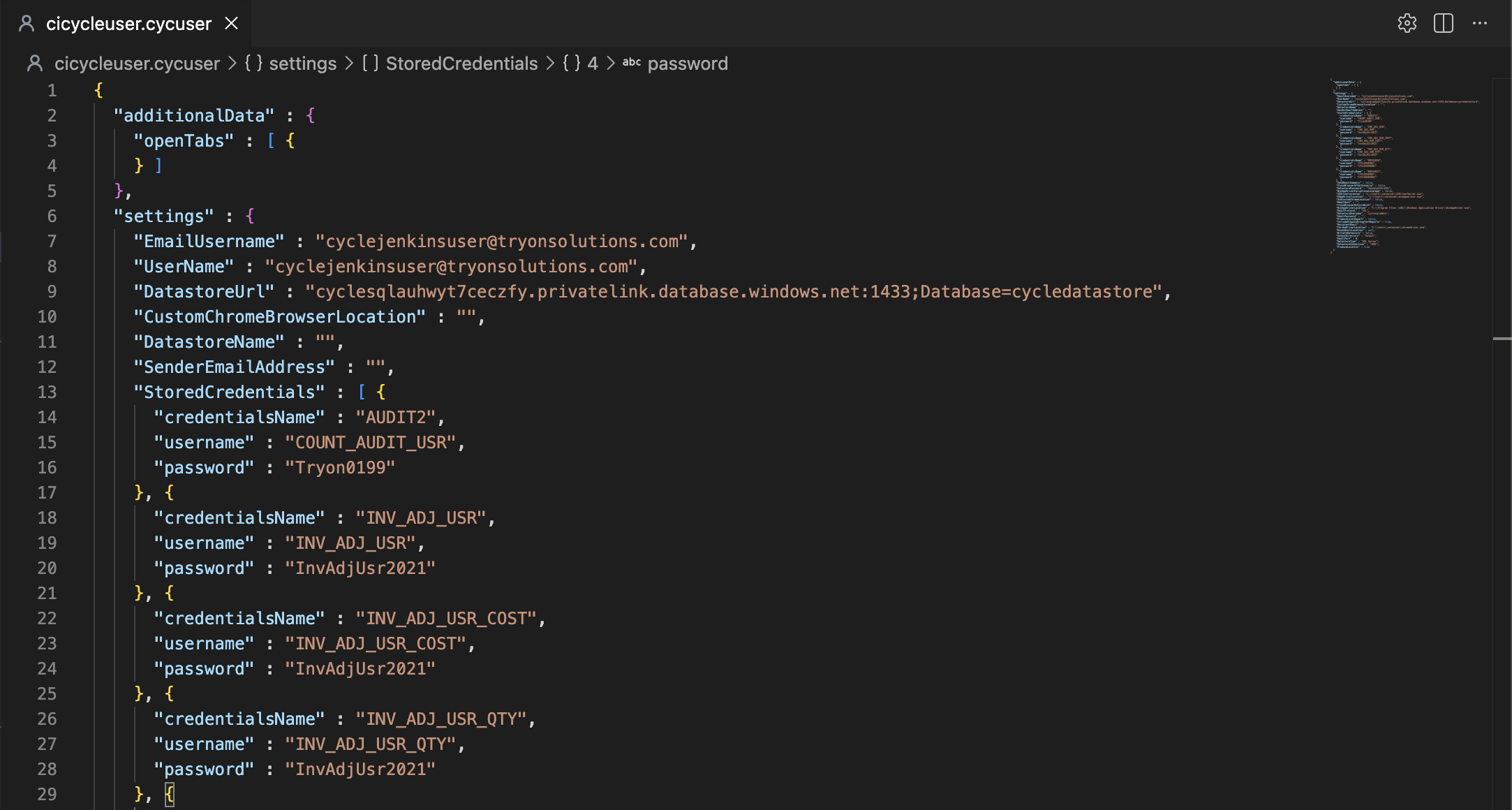
The text editor shows the full .cycuser file as JSON with schema validation.
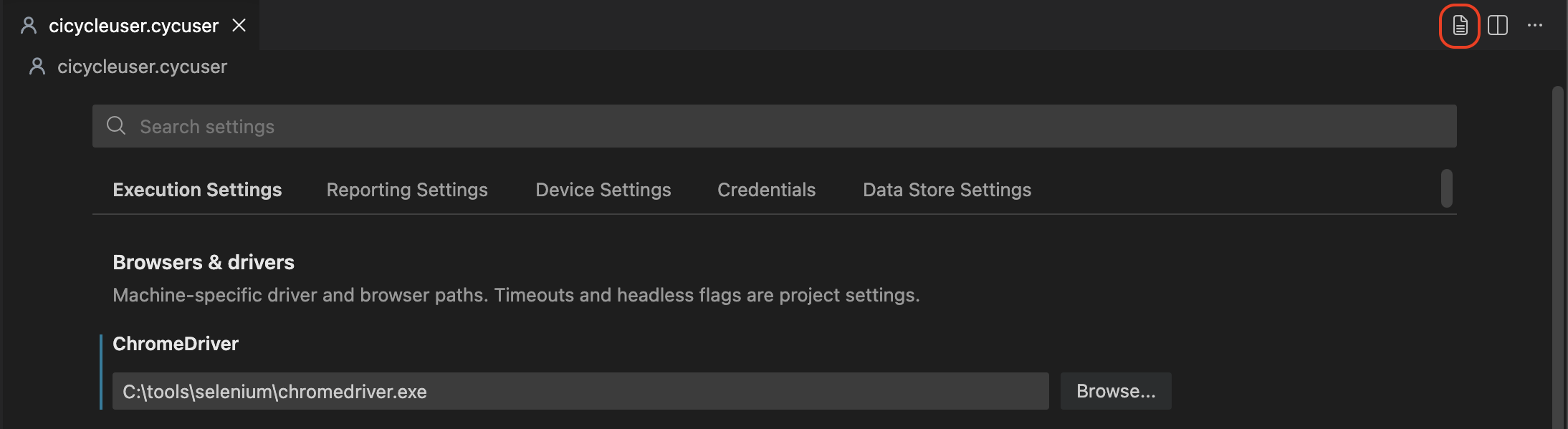
To switch to the text editor, click Open User Settings with Text Editor in the editor title bar (file-text icon).
Only saved settings files can switch editors.
If the file is unsaved, VS Code shows Save this settings file before editing.
The text editor provides:
- Line numbers
- JSON syntax highlighting
- Collapsible JSON sections
- Full manual editing of all fields
- Diagnostics ("red squiggles") for syntax and semantic errors
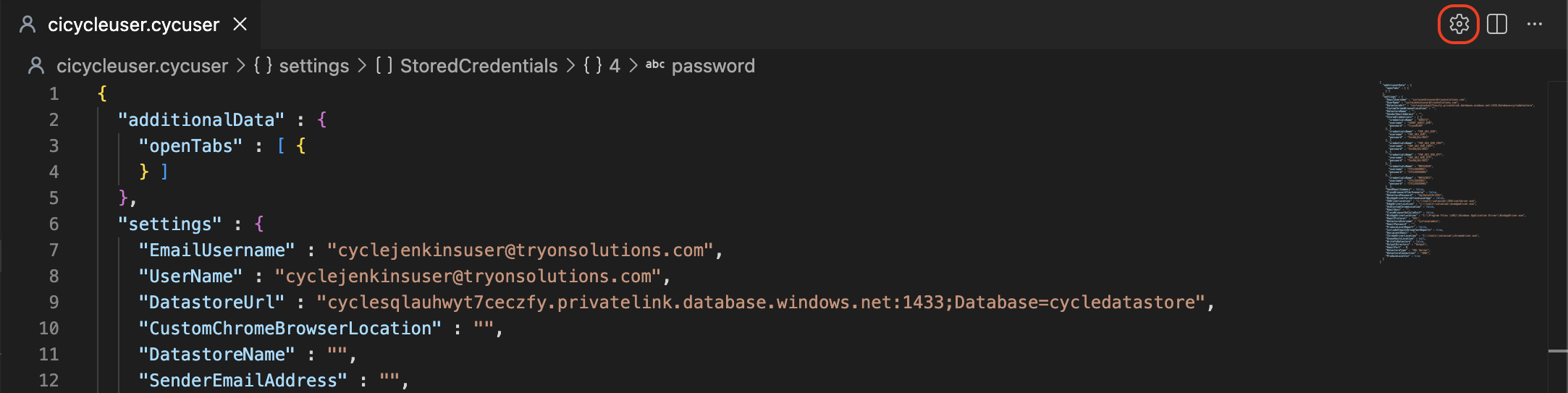
To return to the visual editor, click Open User Settings with Visual Editor in the text editor title bar (settings-gear icon).
Only one view is open at a time per settings file. Save before switching if the file is dirty.
If you have made changes, save the file before switching between the visual and text editors.
Prefer the visual editor rather than the text editor in most cases. The text editor can allow mistakes and syntax errors. Use it for raw or advanced edits and to fix parse errors.
Identifying errors
If a settings file has a syntax error, a red banner appears in the visual editor:
This settings file has a syntax error. Switch to the text editor to fix it:
{detail}

The banner blocks visual editing until you fix the file in the text editor. In the text editor, schema validation shows diagnostics for invalid structure and values.
Sharing and source control
.cycuser filesA personal .cycuser file holds private, machine-specific values such as driver paths, credentials, and local report options.
Do not commit it to version control.
Add personal files such as <username>.cycuser to .gitignore or otherwise exclude them.
A pipeline often needs a dedicated .cycuser file so unattended runs can load the user settings the agent requires.
Name that file for the pipeline rather than a person (for example, jenkins.cycuser) and commit it with the project.
Pass -u (--user-profile) so cycle-cli uses it.
See Running Tests from the Command Line and Running Cycle CLI in Pipelines.
Do not store tokens, passwords, or other secrets in a committed .cycuser file.
Keep those in your CI secret store.
Shareable project settings and connections belong in the .cycproj file.
See Editing Project Settings.