Cycle Testing Process
The Cycle Testing Process has three major phases, all focused on the behaviors of the system under test:
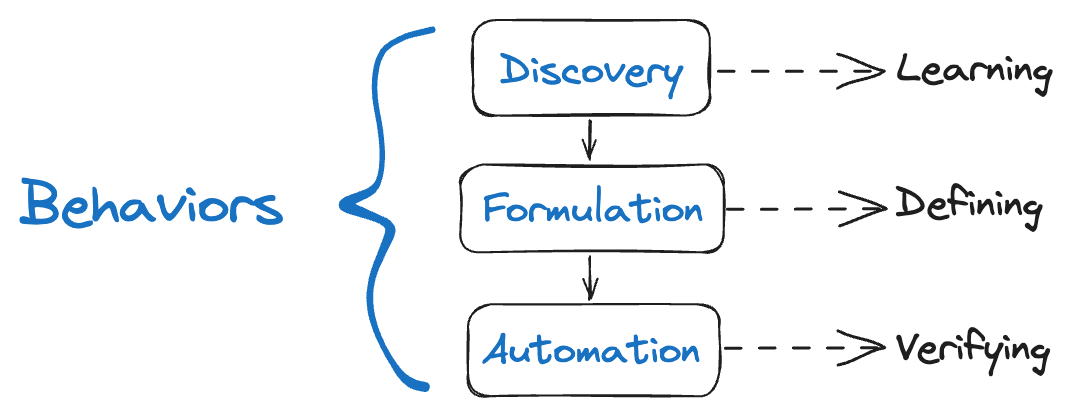
- Discovery: learning about the behaviors to test
- Formulation: defining tests in Feature Files with CycleScript
- Automation: verifying proper behavior by executing automated tests
The Cycle User Manual covers these phases through Cycle Projects content, plus the Desktop and Web platforms that support them. Cycle Intelligence adds AI-powered features that help you move through Discovery into Formulation and Automation faster.
Discovery
Discovery asks the question, "What are the behaviors to test?" It is an activity of learning. Software systems are often very complex. Sometimes they are more complex than any one person can individually comprehend. Teams need time to figure out the behaviors in the system and determine how they should work.
While behaviors are still being designed, Discovery can include activities such as story mapping and example mapping with business, development, and testing roles. If behaviors are already implemented and tests are being automated for regression coverage, Discovery may mean exploring the system, reviewing documentation, and asking questions.
Formulation
Formulation asks the question, "How should the behaviors work?" It is an activity of definition. It puts everything learned during Discovery into clearly written words. In practical terms, this is when test cases are written.
Clear, thorough test cases become living documentation for the system under test and a record of what was developed and tested. In Cycle, tests are formulated using CycleScript, a business-readable language inspired by Gherkin that uses Given-When-Then steps.
Automation
Automation answers the question, "What happens when the behaviors are tried?" It is an activity of verification. A team should be able to know the state of the quality of the system under test at any moment. Automation enables continuous testing by checking the system against the expectations defined in the test specifications.
Automation is more than scripts. It includes the execution platform, environments, tooling for editing and debugging tests, and reporting for results.